MULTIPLE POSITION SENSORS IN A SINGLE HOUSING
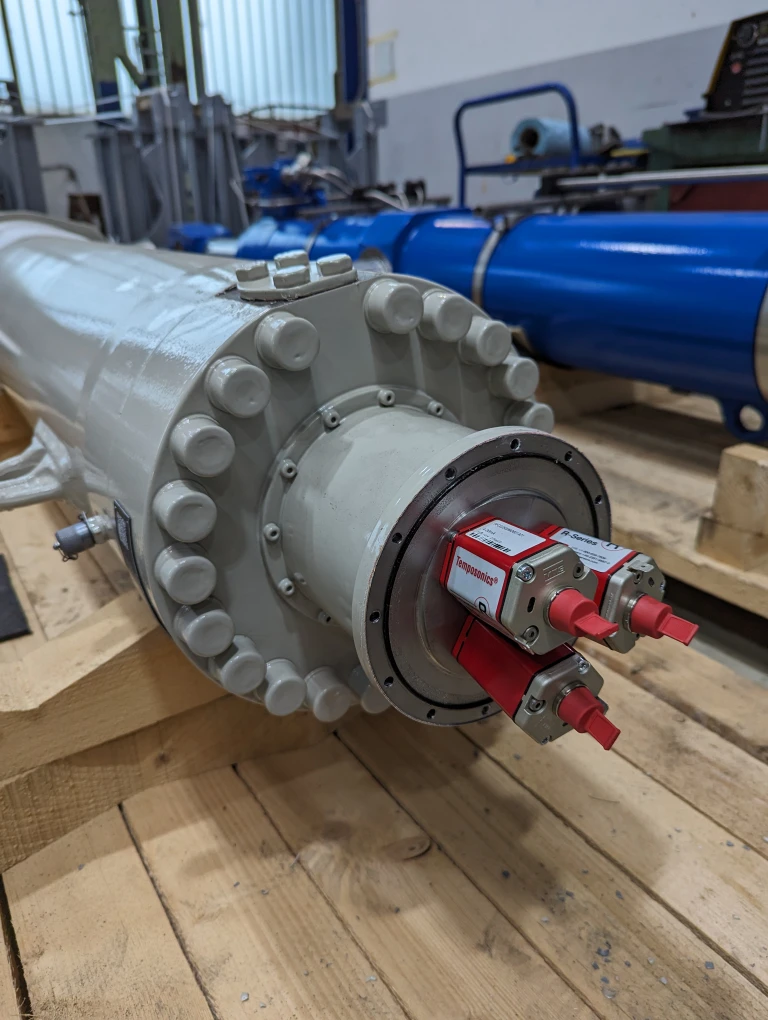
With the goal of optimizing sensor replacement in confined spaces, Temposonics developed a redundant measurement system consisting of three individual position sensors. To integrate three separate sensors into a cylinder with limited space, they must be converged as if in a funnel. This requires sensors whose measuring rods can be bent, such as the Temposonics R-Series V RFV sensor.
Due to the flexibility of their measuring rods, these sensors allow for an arrangement. A holder or sensor carrier is used to mount the three RFV sensors and brings the flexible measuring rods of the sensors together. The three measuring rods are guided through the cylinder in a common pressure-resistant sensor tube. This design offers two key advantages:
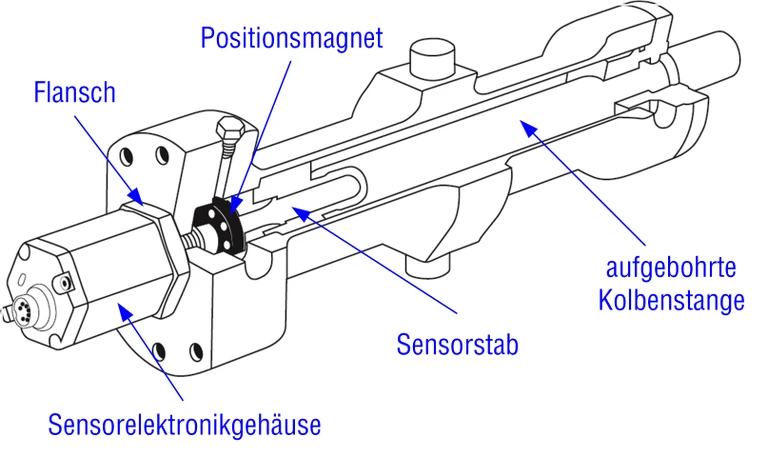
- The sensor tube, which is inserted into the bored-out piston stages of the cylinder, has an outer diameter of only 25 mm. Thus, a small through-hole in the piston rod is required to integrate three individual sensors.
- If necessary, the sensors can be replaced individually.
IMPLEMENTATION AT TWO MAIN WATERLOCK GATES
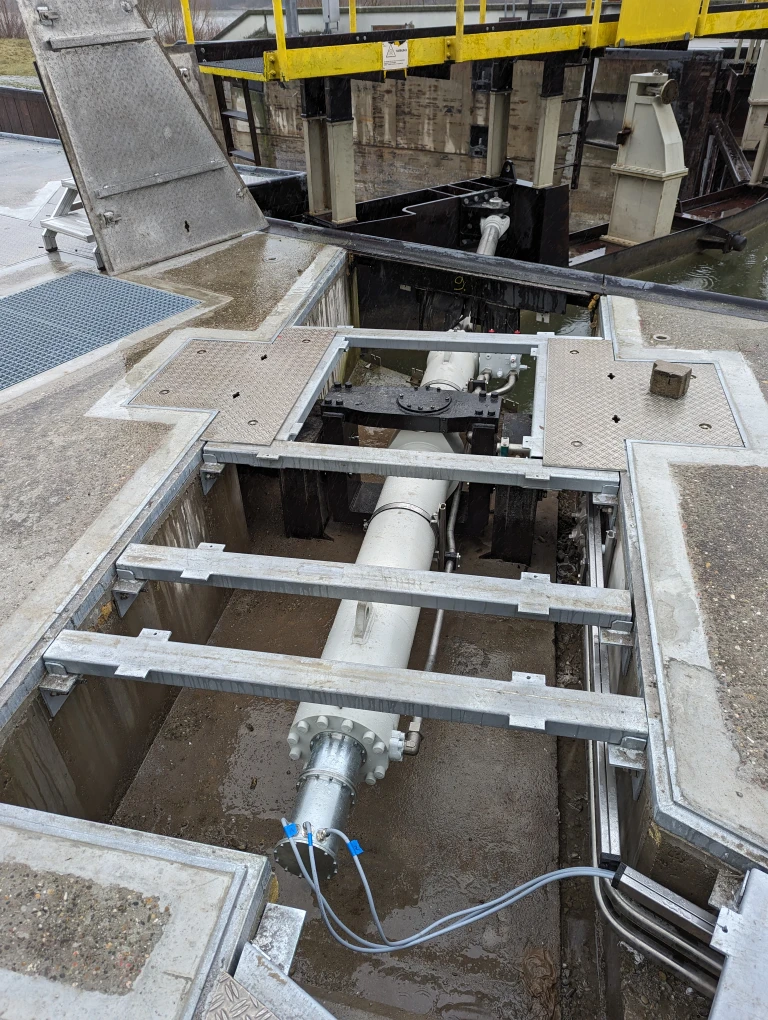
Hydrosaar implemented this solution to set up a redundant measurement system in a hydraulic cylinder for two locks on the Main River. The existing hydraulic cylinders used to move the lock gates were modified and equipped with three individual RFV sensors housed in a sensor tube. To this end, the following modifications were made to the existing cylinders:
- Drilling a deep hole in the piston rod or enlarging the existing deep hole; in one lock, simple position sensors were already used in the cylinder
- Designing the mounting for the position magnet
- Modifying the cylinder base to secure the sensor tube
The H3 sensor tube from Temposonics was used to house the three RFV sensors in the cylinder. The bracket developed by Hydrosaar is designed to accommodate and align the three RFV sensors. This bracket allows for easy insertion of the measuring rods and ensures a secure hold even when the cylinder is vibrating.
The housing protects the three sensor electronics located outside the cylinder from debris in the event of flooding. A distinctive feature of this housing is its two-part design. The sensor carrier separates the upper part from the lower section and serves to hold the sensors. To connect the cables to the sensors, simply remove the cover. The lower part of the housing contains the junction of the three RFV sensors. Both parts of the housing can be removed separately or as a single unit. Due to the housing’s low weight of less than 4 kg, it can be held with one hand by an employee during both installation and removal. The unique feature of the flexible measuring rods offers an enormous advantage during on-site installation or removal: due to the flexibility of the measuring rods, the housing with the sensors can be tilted sideways and removed or installed. This requires only about 500 mm of space behind the cylinder.
This design offers the advantage of allowing sensors to be replaced individually. Thanks to the modular housing, a sensor at a lock can be removed and reinstalled on-site in about 30 minutes. This represents a significant time savings compared to the effort required when the cylinder must be removed to replace a sensor. This implementation demonstrates that it is possible to integrate three individual magnetostrictive position sensors into a single tube within a cylinder with minimal effort: Simple with triple!